Close Search
2026-07-27 /Technical Articles
The efficacy of the MAGICOH binder has been thoroughly validated over many years of formulation practices by various feed manufacturers. Below are some typical application solutions and their effectiveness, as shared by these manufacturers.
1---Optimization to Enhance Water Resistance of Shrimp and Crab Feed (Typical Industry Practice)
Optimization Background: Shrimp feed requires pellet stability in water for over 2 hours; traditional α-starch and gluten meal require high addition levels (2%–4%) and take up valuable space in the nutritional formulation.
Optimization Solution: Substitute natural binders with Magicoh/PMC at an addition rate of 0.2%–0.5% (2–5 kg per metric tonne of feed). If a small quantity of sodium alginate or pregelatinized starch is included to strengthen the surface film, the addition rate of MAGICOH binder can be lowered to 0.2%–0.4%.
Results Achieved:
(1) The feed remains intact in water for 2–4 hours; the dissolution rate is considerably lower than that of the control group, and water stability is significantly enhanced;
(2) 2%–3% of the formulation space is liberated to increase the proportion of high-nutrient ingredients such as proteins and fats;
(3) The pellet durability index (PDI) exceeds 90%, and dust generation during transport is markedly reduced.
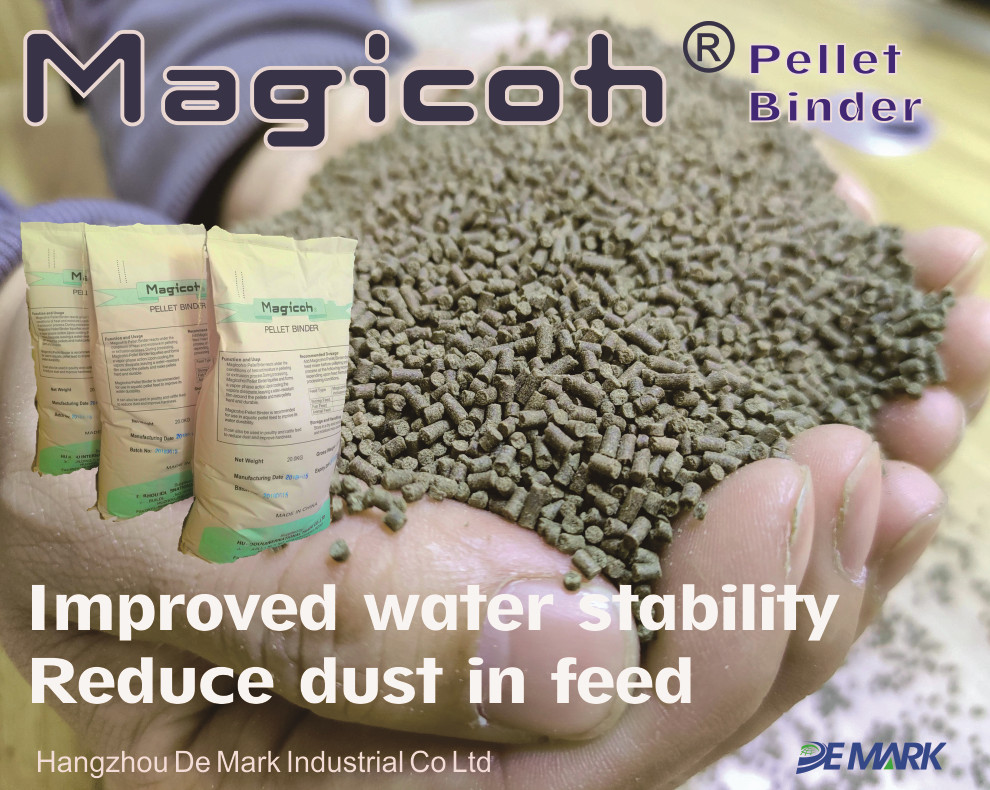
2---Minimizing Dusting Rate in High-Fiber Livestock and Poultry Feed
Optimization Background: Feed for ruminants, pigs, and poultry contains high levels of fiber, such as bran and straw, leading to significant internal voids within the pellets. Conventional binders often fail to create a continuous network, resulting in a dust formation rate that frequently exceeds 8%.
Optimization Solution: Incorporate Magicoh (approximately 1–2 kg/tonne) into the existing formulation; elevate the conditioning temperature to 85–92°C to activate PMC condensation and curing; and prolong the post-cooling curing time to 24–48 hours.
Results Achieved:
(1) The dusting rate decreased from 8%–10% to under 5%;
(2) Pellet hardness saw a moderate improvement, leading to reduced breakage during storage and transport, with no significant refusal to feed noted in the animals.
3---Preventing ‘lubrication-induced delamination’ in high-fat aquatic feed
Optimisation background: When the crude fat content in feed surpasses 8 percent, the fat serves as a lubricant within the pellets, compromising the hydration-curing network and resulting in early disintegration upon contact with water.
Optimisation Strategy: Administer Magicoh at a dosage of 0.2%–0.25% for fish feed and 0.2%–0.5% for shrimp feed, and transition to a post-coating method for the fat/oil to avert disruption of PMC pre-swelling and gelation during the mixing phase.
Achieved Results:
(1) Water resistance of at least 2 hours was preserved even in high-fat formulations;
(2) Prevents problems of uneaten feed accumulating at the bottom of the tank and rising ammonia-nitrogen levels in the water due to inadequate binding.
4---Process-coupled optimisation: Adaptation for low-temperature cold-water fish feed
Optimisation background: In cold-water fish farming (e.g., salmon and trout), where water temperatures drop below 15°C, the hydration and curing rates of PMC-type binders are significantly slowed.
Optimisation approach: Adjust the Magicoh base addition (1.0%-2.0%) by increasing it to 0.15%–0.3%; stabilise the conditioning steam pressure at 0.35–0.4 MPa; prolong the post-pelletisation heat retention and cooling phase; and leverage the hardness-increasing properties of the 24–72-hour post-curing period to offset the limitations at low temperatures.
Results achieved: The pellet integrity rate (water durability) in low-temperature water improved by roughly 30%–40% compared to the non-optimised group.
Overall, the success of the Magicoh formulation optimisation is attributed to the combination of ‘extremely low inclusion + high-temperature conditioning activation + utilisation of post-curing time + synergistic blending of natural binders’. In practical feed mill production, the core performance indicators typically focus on extending water resistance time, reducing dusting rates and unlocking nutritional formulation potential.

We will contact you within 24 hours.