Close Search
2026-07-13 /Technical Articles
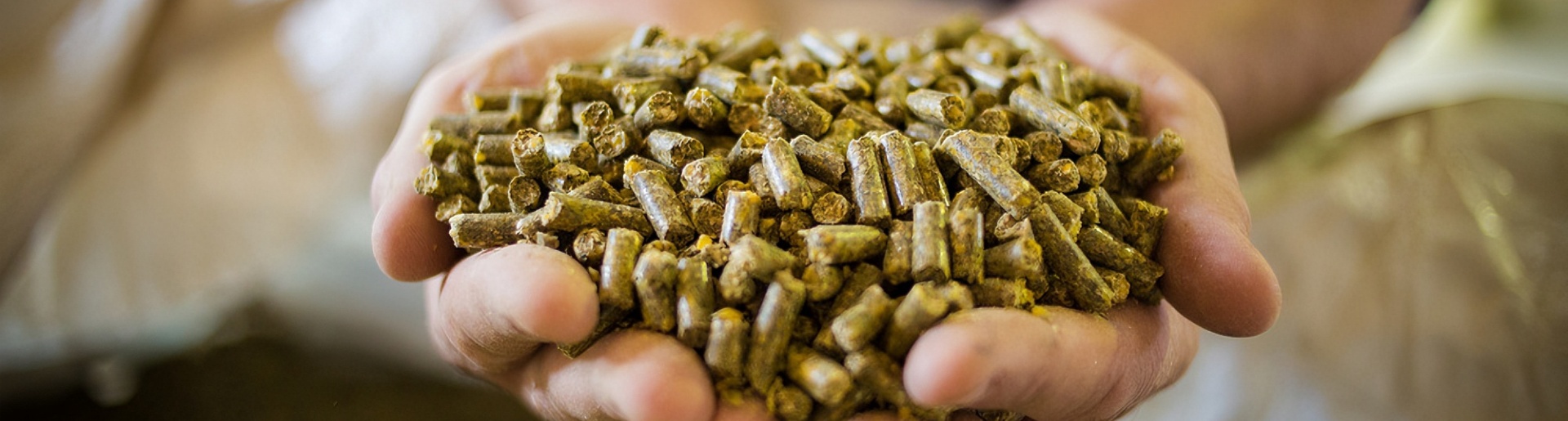
Magicoh is a brand of feed binder supplied by Hangzhou De Mark Industrial Co., Ltd. Its primary ingredient is polymethylolcarbamide (PMC), a modified urea-formaldehyde resin. This binder liquefies when subjected to heat during the pelletizing or extrusion process and, upon cooling, securely binds the feed components to create hard, water-resistant pellets. It has been specifically designed for use in aquaculture, livestock, and poultry pelletized feed, and is compatible with both cold and hot pelletizing systems.
In aquaculture, it can greatly enhance the water stability of feeds for fish, shrimp, and crabs, thereby reducing nutrient loss and minimizing water pollution.
In livestock and poultry production, it can lower dust levels in finished feeds and increase pellet hardness, thus reducing transport losses.
When utilizing Magicoh (polymethylolcarboxamide, PMC) as a feed binder, optimizing feed formulations and application effectiveness involves more than just concentrating on the binder itself. Systematic modifications must be made across three areas: synergistic formulation blending, appropriateness of base ingredients, and integration of process parameters. Below are the specific optimization recommendations we have proposed for your consideration:
I—Optimization of Blending and Synergy at the Binder Formulation Level
Magicoh is a synthetic polymer binder, and its benefits (such as cost-effectiveness, durability, and adaptability to specific aquatic environments) can be enhanced by combining it with natural or semi-synthetic binders:
(1) Binder blending system: In high-fat or specialized aquaculture feeds, the 'Magicoh + a small quantity of natural binder' strategy may be employed. For instance, incorporating 0.3%–0.5% sodium alginate or alginate can create an ionically cross-linked film that improves the water resistance of the pellet surface; or adding 1%–2% gluten flour/pre-gelatinized starch can reinforce the three-dimensional network structure, further enhancing pellet integrity in water.
(2) Introduction of functional additives: When farming in acidic water (pH < 6.5), phosphorylated starch can be utilized in conjunction with Magicoh to enhance acid stability; incorporating 0.05% chitosan complex can prevent microbial degradation of the pellet surface while also providing binding properties.
Caution regarding antagonistic substances: It is advisable to avoid the simultaneous use of high concentrations with high dosage of choline chloride (>0.3%) or strongly acidic or alkaline anti-mould agents, as this may interfere with the PMC’s condensation-curing network, resulting in diminished binding performance.
II----Adaptation to Basic Feed Formulations and Raw Material Characteristics
The binding effectiveness of Magicoh is significantly influenced by the physicochemical characteristics of the base raw materials and should be dynamically modified based on the complete feed formulation:
(1) Adjust dosage according to protein/starch content:
• High-protein formulations (soya meal >30%): Given that protein has natural binding properties, Magicoh can be applied at the lower end of the recommended dosage range (e.g., around 2 kg/tonne for fish feed, 4 kg/tonne for shrimp feed);
• Low-starch/high-fibre formulations (rich in bran and straw): Since fibre hinders binding, the addition rate should be increased by 0.1%–0.2% or supplemented with 1%–2% pre-gelatinised starch to strengthen the network.
(2) Compensation for fat content: When the crude fat in the feed exceeds 8%, the fat lubricates the pellet interfaces, weakening hydration and solidification; an extra 0.1%–0.2% of Magicoh should be added, or a post-coating process for fats/oils should be implemented (to prevent disruption of gelation during the mixing phase).
(3) Control of raw material fineness: The suggested particle size for the base feed is ≥80–120 mesh. If the material is too coarse, it will increase the internal porosity of the pellets and hasten water absorption and disintegration. Conversely, if it is too fine, it will lead to high energy consumption. A uniform and fine powder enables Magicoh come into fuller contact with cellulose, starch and protein to form ether bonds.
III—Optimization of Process Parameters, Mixing and Curing Conditions
Magicoh cures through a condensation reaction initiated by high-temperature steam; not adhering to the correct procedure can lead to a considerable loss of its bonding capabilities:
(1) Accurate Addition and Mixing:
It is advisable to introduce Magicoh directly into the mixer as the last raw material, employing a stepwise pre-mixing method (initially dry-mixing with 1/10 of the main material for 3 minutes, followed by complete mixing) to guarantee uniformity across 2–3 mixing stages and to avoid localized agglomeration or uneven distribution.
Moisture content should be regulated at 16%–18% before conditioning to facilitate adequate water absorption and pre-swelling of the PMC; bonding performance can be enhanced by approximately 50% in a high-moisture setting.
(2) Conditioning Temperature and Steam Pressure:
Sustain a steam pressure of 0.3–0.4 MPa and a conditioning temperature of 85–92 °C to ensure comprehensive condensation and curing of Magicoh with the material, while also promoting protein denaturation and cross-linking.
For hard aquatic pellets, the ring die compression ratio may be suitably decreased (for instance, from 1:13 to 1:9–1:10); with the robust support provided by Magicoh, a PDI of ≥90% can still be achieved, while also boosting output and minimizing consumption.
(3) Post-curing and Cooling Period:
Permit the pellets to cool for 24–72 hours following pelletization before packaging. During this cooling phase, the network structure of PMC will continue to evolve in terms of hardness and water resistance (a typical aging characteristic of this binder type).
Ensure a consistent cooling air velocity of 1.8–2.2 m/s and regulate the final moisture content at 10.5% ± 0.3% to avert premature disintegration upon water contact due to surface microcracks.
(4) Strategies for Fine-tuning Environmental and Cost Factors
Temperature, humidity, and season: When the water temperature surpasses 28 °C or the workshop humidity exceeds 60 percent, it may be beneficial to slightly lower the addition rate to avoid the pellets becoming overly hard, which could impact their palatability. For feeds intended for cold-water fish, a marginally higher binder quantity should be incorporated compared to those for warm-water fish to offset the slower hydration rate at lower temperatures.
Economic Substitution Threshold: Given that the Magicoh addition rate is very minimal (0.1%–0.2%, equivalent to 1–2 kg/tonne), the objective should be to maximize its substitution capabilities—without sacrificing nutritional quality, Magicoh should substitute the 2%–4% of wheat flour/gluten meal that was initially used for binding, thereby freeing up space for the inclusion of high-protein and other nutritional components.
By considering specific cultivated species (such as shrimp, fish, poultry, or livestock) and the estimated proportions of the base formulation, we can assist you in determining a more accurate set of Magicoh dosage and blending suggestions. Would you like to explore this further with us? Please do not hesitate to reach out to us at:
Mr. Ronnick FONG
Email: jzfong@de-mark.com
WhatsApp: +8613588089289
Miss Nancy Wang
Email: sales@de-mark.com
WhatsApp: +8617367106011

We will contact you within 24 hours.